Key Takeaways
- A retractable canopy for a pergola is a fabric membrane on a sliding frame; a louvered roof like the Azenco R-Blade is a fully motorized aluminum structure with pivoting slats.
- Fabric canopies are generally meant to be retracted ahead of high wind or sustained storms; a closed R-Blade is engineered up to 195 mph and Miami-Dade certified.
- Louvered roofs carry integrated drainage through the frame and posts; fabric canopies rely on pitch, tension, and retraction timing to manage water.
- Adding a fabric canopy to an existing pergola is often possible with an engineering check; converting to a true louvered roof is closer to a new structure than a retrofit.
People searching for a "retractable canopy for pergola" are usually picturing one of two very different products. One is a fabric shade that slides or folds back on a track, essentially a cousin of a retractable awning built to sit over an open frame. The other is a motorized louvered roof, where the aluminum itself opens and closes — the canopy isn't cloth at all, it's an engineered structure. We install both at Breslow — see examples of each in our project portfolio — so this isn't a sales pitch for one over the other. It's a straight comparison of what each actually does once it's on your property.
The Fabric Canopy, Explained
A fabric retractable canopy is a solution-dyed acrylic membrane — the same family of fabrics used on retractable awnings — mounted on a lightweight frame that slides along a track or folds accordion-style. Extended, it casts a soft, even shade. Retracted, it disappears to a slim housing and gives you an open sky again. Most quality systems today are motorized with a remote, sometimes paired with a sun or wind sensor, though manual versions still exist for smaller spans. The appeal is real: it's a lighter-weight addition, it comes in a wide range of colors and patterns, and for a pergola that already has a structural frame, it can be a comparatively simple way to add shade.
The Louvered Roof, Explained
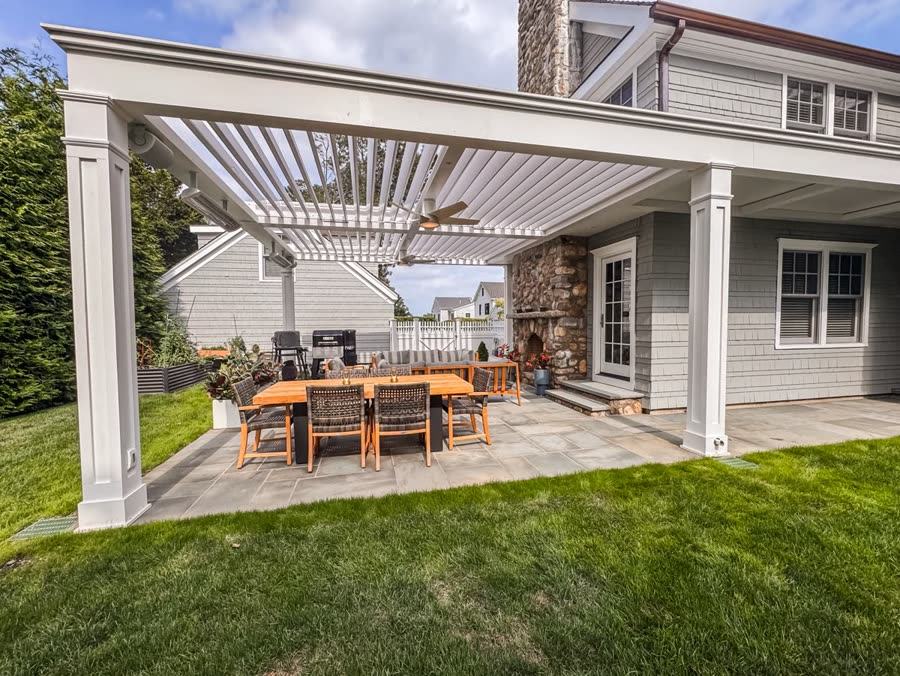
A motorized louvered roof, like the Azenco R-Blade Breslow installs, works on an entirely different principle. The roof itself is built from aluminum blades — the louvers — that pivot on command, by remote or weather sensor, between fully open and fully closed. There's no fabric anywhere in the system. Open, it reads almost like a pergola with no roof at all. Closed, the blades seat against each other to form one continuous, weather-tight surface. It's available in 200+ RAL colors, so the frame itself is finished to match a home rather than dressed up with a separate fabric pattern.
Rain: Shedding vs Sealing
This is where the two products genuinely part ways. A fabric canopy, even a well-built one, sheds light rain while it's pitched and extended, but it isn't designed to be left out indefinitely through a downpour — most manufacturers instruct owners to retract before sustained rain or a wind advisory, the same way you would with a retractable awning. A closed R-Blade behaves differently: the louvers seal into a continuous roof, and water is carried off through drainage built into the frame and routed down through the posts, rather than left to pool on cloth or run off the edge of a track. One system is designed to get out of the weather's way; the other is designed to stand in it.
“We usually leave it here and then if we're gone for the day and it starts to rain, the sensors close it for us.”
— Homeowners, Fairfield County CT · watch real client clips
Wind Ratings Compared
Fabric canopies are generally built for light-to-moderate wind exposure, and part of living with one is knowing when to bring it in — most manufacturers publish a maximum wind speed for safe extension and recommend retracting well before conditions approach it. A closed R-Blade is engineered to a different standard entirely: up to 195 mph, Miami-Dade hurricane certified. Open-louver ratings vary by span and should always be confirmed against the specific structure — consult a licensed engineer for final design on any project — but the gap between "retract it before the wind picks up" and "engineered to stay closed through a hurricane-rated event" is the core difference between the two products.
| Attribute | Fabric Retractable Canopy | Azenco R-Blade Louvered Roof |
|---|---|---|
| Roof surface | Solution-dyed acrylic fabric | Powder-coated aluminum louvers |
| Rain handling | Sheds while extended; retract before storms | Seals closed; integrated drainage through frame and posts |
| Wind rating | Light-to-moderate; retract in high wind (varies by model) | Up to 195 mph, Miami-Dade certified when closed |
| Lifespan | Frame: many years; fabric: a wear item, replaced periodically | Aluminum frame built for decades of Northeast weather |
| Maintenance | Periodic cleaning, re-tensioning, fabric care | Minimal; no fabric surface to fade or replace |
Lifespan and Maintenance
A quality fabric canopy in solution-dyed acrylic resists fading and mildew reasonably well, but the fabric is still a wear item — years of UV exposure, tension cycles, and Northeast humidity mean it will eventually need cleaning, re-tensioning, or replacement, well ahead of when the frame itself would fail. A louvered roof sidesteps that entirely: the finished surface is powder-coated aluminum, not cloth, so there's nothing to fade, tear, or re-cover. Breslow backs every R-Blade installation with a 5-year structural warranty in addition to Azenco's manufacturer warranty on the louver mechanism and motors — coverage worth asking about no matter which system you're comparing.
Retrofitting an Existing Pergola
If you already have a pergola frame, adding a motorized fabric canopy on top is often realistic, provided an engineer confirms the existing structure can carry the added wind load and mounting hardware — that check matters more than people assume, since a frame built for an open lattice wasn't necessarily designed to carry a taut fabric sail. Converting that same structure into a true louvered roof is a different scope of work. An R-Blade is engineered as one integrated system — posts, beams, and louvers sized together — so most homeowners who want that specific performance end up replacing the overhead structure rather than retrofitting the old one.
Ask your contractor: what's the maximum sustained wind this canopy is rated to stay extended in, and who tested that number?
Both products solve the same basic problem — too much sun, not enough shelter — but they solve it at different levels of permanence. A fabric canopy is a lighter, more affordable way to add shade to a space that already has a frame. A louvered roof is a structural decision, engineered to stand up to Northeast weather without being retracted out of harm's way first. Neither is universally "better"; the right one depends on what you're asking the space to do in a storm, not just on a sunny afternoon.
Frequently Asked Questions
What is a retractable canopy for a pergola?
It's a fabric membrane, usually a solution-dyed acrylic, mounted on a sliding or folding frame across the top of a pergola or between posts. It can be opened by hand or by a Somfy motor and remote, and it shades the space when extended without the cost or permanence of a solid roof.
Can I add a retractable canopy to an existing pergola?
Often, yes, provided the existing frame can carry the added wind load and mounting points, which should be confirmed before installation. Converting the same structure into a true motorized louvered roof is a different project, since a system like the Azenco R-Blade is engineered as one integrated structure rather than an add-on.
How does a fabric canopy compare to a louvered roof in the rain?
A fabric canopy sheds light rain while pitched and extended, but manufacturers generally recommend retracting it before sustained storms. A closed louvered roof forms one continuous, weather-sealed surface with drainage built into the frame and posts, so it's designed to stay closed through the weather rather than be retracted away from it.
Which lasts longer, a fabric canopy or an aluminum louvered roof?
The aluminum frame of a louvered roof is built to last for decades with routine care, since there's no fabric surface to fade or replace. A fabric canopy's frame can also last many years, but the fabric itself is a wear item that will eventually need cleaning, re-tensioning, or replacement well before the frame does.