Key Takeaways
- Most motorized screens on the market bolt a visible motor tube and exposed tracks onto the outside of a structure's beams and posts.
- Breslow conceals the motor inside the beam and recesses the tracks into the posts, so hardware disappears whether the screen is open or closed.
- New-construction R-Blade™ pergolas can have concealment channels engineered in from the start; existing structures get custom-fabricated concealment on retrofit.
- The result reads as architecture, not an accessory bolted on after the structure was built.
Look up at most motorized screen installations and you'll see the hardware before you see anything else: a fat tube running the length of the beam, tracks bolted to the face of each post, a housing that looks like it was added after the fact — because it usually was. The alternative is to design the concealment in from the start, so the only thing visible is the mesh itself, and only when it's actually deployed.
The Problem With Visible Screen Hardware
A motorized screen earns its keep by disappearing when it's not needed. That promise breaks the moment the motor housing and tracks are exposed on the surface of the structure, because now there's visible hardware whether the screen is up or down. On a pergola or porch designed with real architectural intent, a bolted-on motor tube reads the same way an exposed conduit reads on a finished ceiling — functional, but a compromise nobody wanted to make.
This is where a lot of screen installations fall short, not because the screen itself performs poorly, but because the integration was an afterthought rather than a design decision. Screens are frequently added after a structure is already standing, and the fastest path to installing them is simply clamping components to whatever surface is available. That approach solves the immediate problem — bugs, wind, glare — while creating a permanent, visible reminder that the feature was bolted on rather than built in.
What Concealed Actually Means
Concealed motor and track integration means the mechanical components live inside the structural members of the pergola or porch, not attached to their outer surface. The motor sits inside the beam header rather than in a tube hanging beneath it. The track that guides the screen up and down runs inside a channel machined or extruded into the post, rather than as a separate rail bolted to the outside face.
The practical result: when the screen is retracted, there's nothing to look at but the beam and post themselves — no visible housing, no external rail. When it's deployed, the only thing you see is mesh.
This isn't a purely cosmetic distinction, either. Hardware exposed to direct sun, rain, and salt air ages differently than hardware sheltered inside a structural channel. A concealed track and motor housing see less direct weathering over the years than an exposed one, which is a secondary benefit of the same design decision that makes the system look better on day one.
Tracks Recessed Into the Structure
| Detail | Concealed System | Surface-Mounted System |
|---|---|---|
| Track location | Recessed into a channel within the post | Bolted to the outside face of the post |
| Motor housing | Built into the structural beam | Exposed tube mounted beneath or in front of the beam |
| Visible profile, screen open | Clean beam and post lines, no hardware visible | Housing and track visible even when retracted |
| Typical application | Designed into new-build pergolas from the start | Common on retrofits with no dedicated channel |
The recessed track is the more visible half of the concealment story, since it runs the full height of every post the screen travels along. Cutting or extruding that channel into the post itself — rather than adding a rail after the fact — is what allows the screen to travel inside the structure's own lines instead of alongside them.
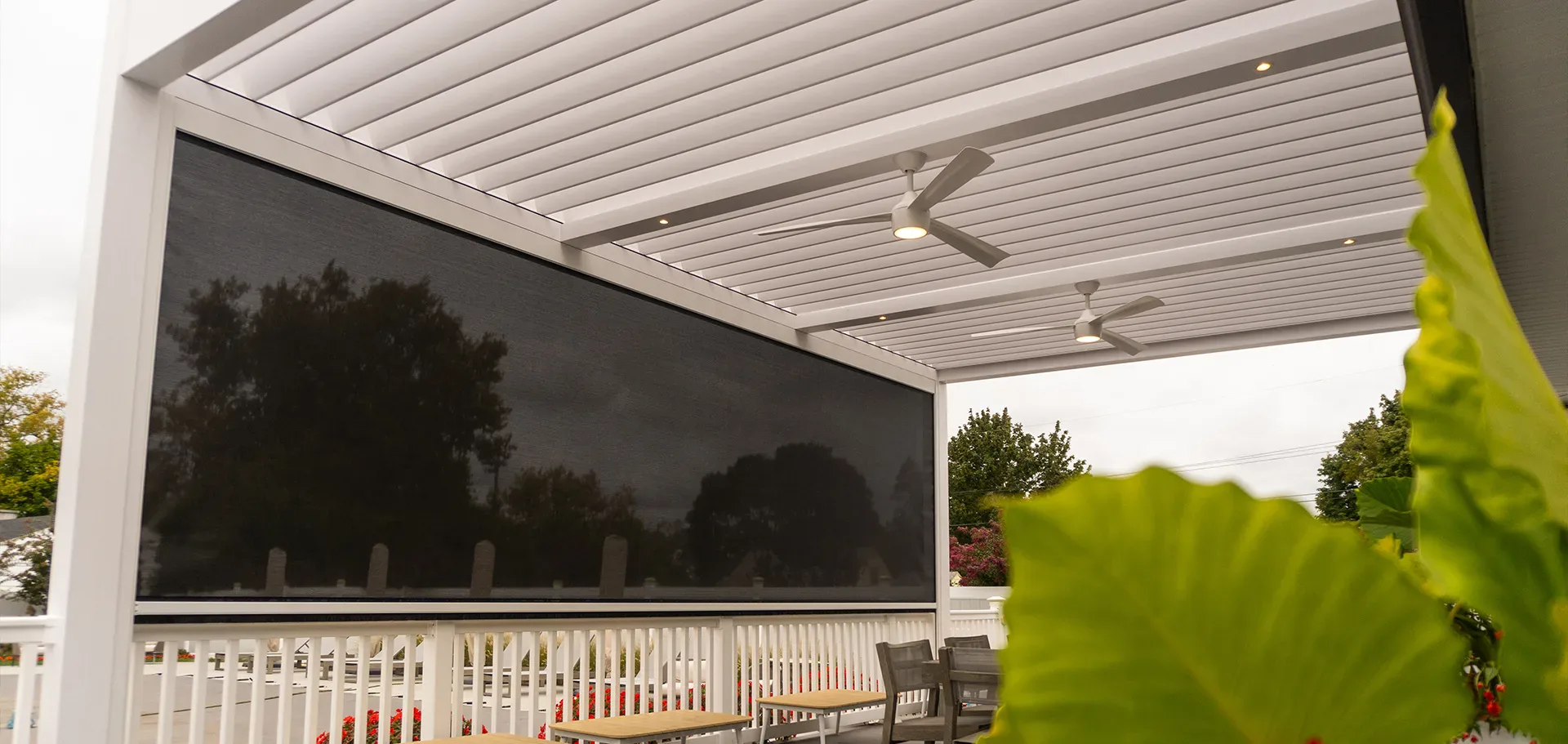
Motors You Never See
The motor is the part most surface-mounted systems expose without much thought, because housing it inside the beam takes more engineering upfront than clamping a tube underneath. A beam-integrated motor housing has to be sized correctly at the structural design stage, matched to the beam's finish so any access panel blends rather than stands out, and positioned for service access without being visible in daily use. It's a harder engineering problem, which is exactly why it's a meaningful differentiator rather than a cosmetic one.
That upfront engineering has a downstream payoff: a beam wide enough to house the motor cleanly is decided during design, before fabrication begins, rather than discovered as a problem once the screen is ready to install and there's nowhere obvious to put the motor. Retrofitting concealment onto an already-finished beam is far harder than designing for it from the start, which is exactly why the sequence matters.
Retrofits vs. Designed-In Screens
New-construction R-Blade™ projects have the advantage of concealment channels engineered into the extrusion from day one — the structure and the screen system are one design, not two. Retrofitting screens onto an existing porch or patio doesn't have that luxury; the framing wasn't built with a channel in mind. In those cases, Breslow custom-fabricates housing and mounting brackets sized to the existing structure, using our own motorized screens capability to conceal as much of the hardware as the existing framing allows, even if it can't match a purpose-built channel exactly.
The gap between the two isn't binary. A retrofit with thoughtfully custom-fabricated housing, color-matched to the existing beam and positioned to minimize its footprint, comes far closer to a designed-in result than a stock surface-mount kit ever will. It simply takes more design and fabrication effort to get there on a structure that wasn't planned around it.
Ask your contractor: when the screen is fully retracted, what's still visible on the beam and posts?
That single question separates a system designed to disappear from one that was simply attached.
See It in Person
Photos and renderings only communicate so much about how a concealed track actually sits inside a post. The clearest way to evaluate it is to see the detail directly — at our private North Jersey showroom by appointment, or walked through on a Zoom consultation using real project footage. Either way, start by scheduling a consultation and asking to see the concealment detail up close before deciding what belongs on your structure.
Frequently Asked Questions
What does "concealed motor" mean for a motorized screen?
It means the motor that drives the screen is housed inside the structural beam of the pergola or porch rather than mounted as a visible tube on the outside. The mechanical components are built into the structure instead of attached to its surface.
Are concealed tracks harder to service than surface-mounted ones?
Concealed systems are engineered with service access built into the housing design, so a technician can reach the motor and track without dismantling the structure. The access point is simply designed to be discreet rather than exposed at all times.
Can concealed screens be added to an existing structure, or only new pergolas?
New-construction pergolas can have concealment channels engineered into the extrusion from the start, which is the cleanest integration. Existing porches and patios can still be retrofitted, using custom-fabricated housing and brackets sized to the existing framing to conceal as much hardware as possible.
Why do visible screen tracks and motors matter aesthetically?
A motorized screen is meant to disappear when it's retracted. If the motor housing and tracks are bolted to the outside of the structure, there's visible hardware whether the screen is open or closed, which undercuts the clean architectural line the structure was designed to have.